




A Marriage Compatibility Checklist for Real-Life Decisions
People-first marriage compatibility planning guide
A Marriage Compatibility Checklist for Real-Life Decisions
Short answer: A useful marriage compatibility checklist begins with real-life evidence: mutual respect, free consent, emotional and physical safety, conflict repair, values, money, family boundaries, children, work, housing, health support and future goals. Astrology can be used as an optional reflective tradition, but a chart score cannot prove love, predict marriage success, excuse abuse or replace legal, financial, medical or counselling advice.
Compatibility is not a single score. Two people can share interests and still disagree about debt, children, caregiving, faith or where to live. They can also have a favourable chart and an unsafe relationship. A responsible checklist helps both partners name the decisions they will actually live.
This guide is deliberately separated from World Astro’s existing marriage-chart checklist, chart-accuracy and marriage-help articles. It does not teach scoring or prescribe remedies. It puts consent and safety first, creates practical discussion records and shows where an optional astrology consultation can—and cannot—fit.

Key Takeaways
- Consent and safety are paramount in any relationship planning.
- Discuss real-life scenarios to evaluate compatibility, not just abstract values.
- Financial transparency is crucial before making commitments.
- Conflict resolution strategies should be established to maintain a healthy relationship.
- Astrology can serve as a reflective tool, but it should not dictate relationship decisions.
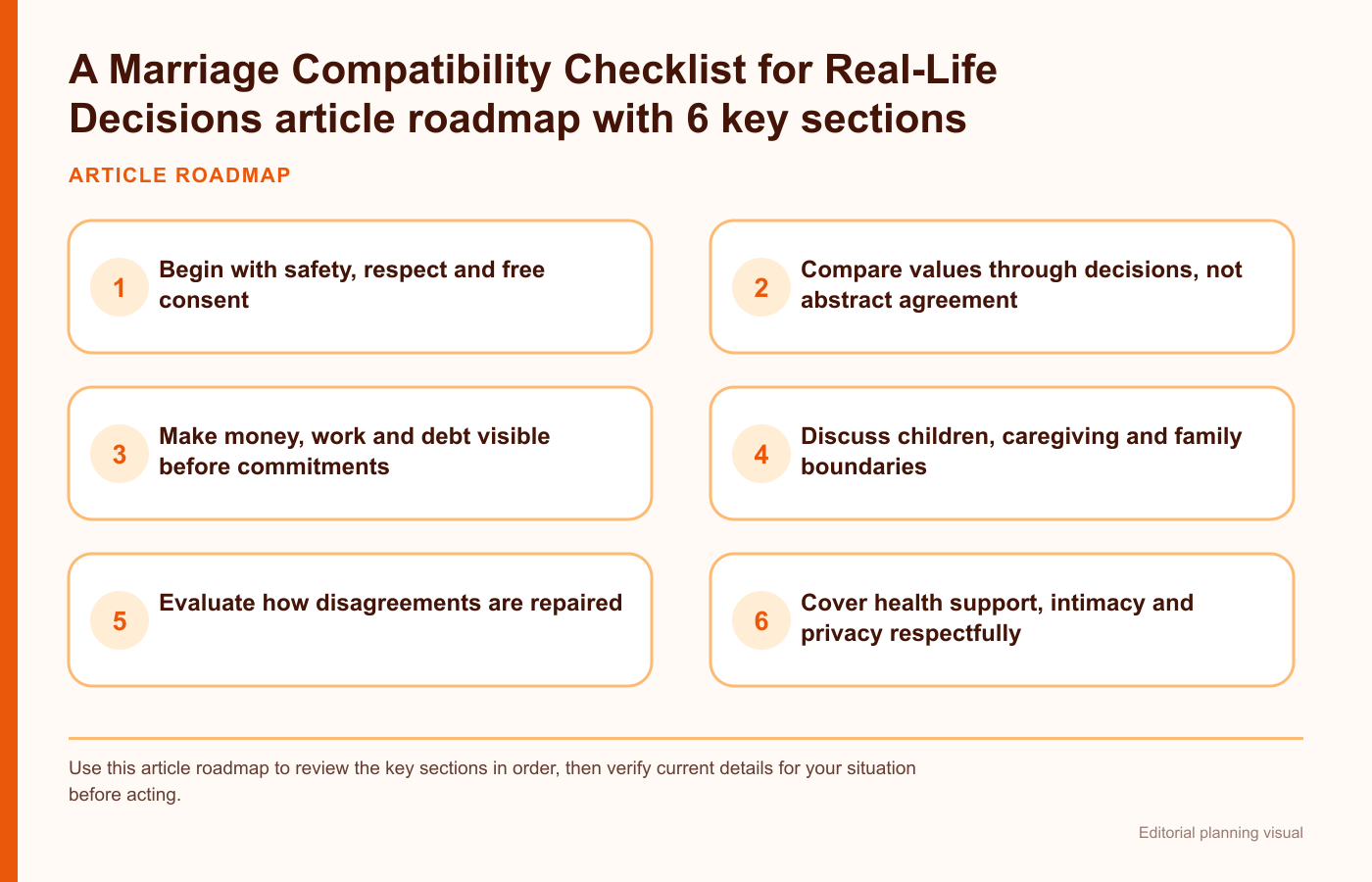
Begin with safety, respect and free consent
Both people must be able to say yes, no, not yet or I changed my mind without threats, punishment, surveillance, financial control, family coercion or spiritual pressure. A wedding deadline, sunk cost or chart interpretation does not override consent.
Women and Gender Equality Canada’s healthy relationship module contrasts open communication and respect with manipulation, isolation, extreme jealousy, threats, intimidation, coercion and financial control. These behaviours are not “compatibility challenges” to solve with a remedy.
If anyone is in immediate danger, call 911. Justice Canada’s family violence help page explains safety planning and points to police, victim services, shelters, health services and community organizations. Do not conduct a joint checklist or consultation when doing so could increase risk. Seek private, qualified support.
Compare values through decisions, not abstract agreement
Ask each person to describe what a good partnership looks like on an ordinary Tuesday. Discuss honesty, privacy, faith, community, generosity, ambition, leisure, substance use, digital boundaries and how major decisions are made. “Family is important” can mean daily involvement to one person and occasional gatherings to another.
Use scenarios: one partner receives a job offer in another city; a parent needs care; an old friend needs temporary housing; a religious practice changes; one partner wants more privacy online. The goal is not identical answers. It is knowing whether differences can be negotiated respectfully.
Record open questions and the date to revisit them. Do not treat silence, deference or family approval as the person’s own agreement.
Make money, work and debt visible before commitments
Share an honest picture of income, debt, credit obligations, assets, financial dependants and current spending responsibilities. Discuss joint and separate accounts, bill allocation, saving, gifts to relatives, risk tolerance, major purchases and what requires two-person approval.
Talk about unpaid labour: cooking, cleaning, scheduling, caregiving and emotional work. Agree how work changes, parental leave, disability or unemployment would affect responsibilities. A chart cannot replace a budget or independent financial advice.
For marriage contracts, property rights, sponsorship, immigration, tax or estate questions, each person may need independent legal advice. This article and an astrologer cannot determine legal rights.
Discuss children, caregiving and family boundaries
Ask whether each person wants children, is uncertain or does not. Discuss timing, fertility uncertainty, adoption or other paths only as personally relevant. No one should promise a child or medical outcome. Health and fertility decisions belong with qualified healthcare professionals.
Discuss parenting values, discipline, education, religion, language, names, childcare and work roles. Identify who may provide care and what boundaries apply to grandparents and extended family. Partners do not need every answer now, but concealed opposition is not a minor detail.
Include caregiving for parents, siblings or other dependants, holidays, household visits and financial support. Cultural tradition can guide a couple, but it should not erase either person’s consent or safety.
Evaluate how disagreements are repaired
Compatibility is visible after a disagreement. Can both people pause, listen, take responsibility, apologize specifically and change behaviour? Can they discuss one issue without insults, threats, silent punishment, property damage or recruiting family members to overpower the other?
Create a repair plan: which topics need a scheduled conversation, how time-outs work, when the discussion resumes and when a qualified couples counsellor is appropriate. Counselling is not automatically safe when abuse or coercive control exists; seek specialized individual advice first.
| Pattern | Constructive sign | Stop or escalation signal |
|---|---|---|
| Disagreement | Both can speak and pause without retaliation | Threats, intimidation, humiliation or violence |
| Boundary | A no is respected | Monitoring, stalking, coercion or punishment |
| Money | Information and decisions are transparent | Hidden debt, theft or financial control |
| Family pressure | The couple can make free decisions | Forced consent or fear of consequences |
| Repair | Responsibility leads to sustained change | Blame, denial or repeated harm |
Cover health support, intimacy and privacy respectfully
Discuss how each person prefers to receive support during illness, stress or disability and which health information remains private. No partner is entitled to diagnose, control treatment or use health information as leverage. Astrology must not predict disease, pregnancy, lifespan or treatment outcome.
Intimacy requires ongoing, freely given consent. Discuss affection, sexual expectations, contraception, testing, privacy and how either person can decline without punishment. Seek qualified medical advice for sexual and reproductive health.
Also discuss sleep, substance use, gambling, online behaviour and mental-health support as real-life practices. The aim is not to demand a perfect history; it is honest information, appropriate boundaries and willingness to obtain qualified help.
Use astrology as optional reflection, never a verdict
World Astro’s current relationship chart page describes eight horoscope-matching factors and requests names, email, gender, date, time and place of birth for both people. It says submitted information is confidential, but users should review current privacy, retention, payment and consent terms before sharing either partner’s data.
A chart may prompt a conversation about temperament, values or timing for people who choose that tradition. It cannot verify character, consent, safety, medical compatibility, fertility, legal rights or the future of a marriage. A low or high score should not pressure someone to marry, stay or separate.
If consulting World Astro or another practitioner, ask what method will be used, what information is required, what the session delivers, what it costs and what claims the practitioner will not make. Both partners should consent before personal birth information is submitted.
Use this pre-decision compatibility checklist
- Both people can consent freely and change their mind safely.
- Each person’s non-negotiable values and flexible preferences are named.
- Income, debt, spending, saving and dependants are honestly disclosed.
- Work, housework and caregiving expectations are practical.
- Children and parenting positions are discussed without coercion.
- Family, cultural, faith and holiday boundaries are explicit.
- Housing, location and career-move scenarios are considered.
- Conflict rules prohibit abuse and include a repair process.
- Health, intimacy, digital privacy and substance-use boundaries are respected.
- Legal, financial, medical and counselling questions go to qualified professionals.
- Any astrology reading is optional, consented to and treated as reflection.
- Open issues have owners, next steps and a date to revisit.
Do not force a one-meeting conclusion. Some items need documents, professional advice or separate private reflection. “Not ready” is useful information.
Common marriage compatibility mistakes to avoid
- Reducing the decision to a horoscope or point score.
- Treating abuse, coercion or control as a remedy problem.
- Assuming family approval equals both partners’ consent.
- Discussing values without real scenarios and responsibilities.
- Hiding debt, dependants, health needs or major expectations.
- Using counselling jointly when specialized safety advice is needed.
- Sharing a partner’s birth data without their knowledge and consent.
- Letting an astrologer replace legal, financial, medical or mental-health professionals.
Frequently asked questions
Can a compatibility chart predict a successful marriage?
No chart can guarantee an outcome. Relationship behaviour, consent, safety, circumstances and choices remain essential.
What birth information does World Astro request?
Its current relationship-chart form asks for both partners’ names, emails, gender, birth date, birth time and birth place. Review privacy and obtain consent first.
Should a couple ignore a low astrology score?
Do not use a score as a command. Ask what the method means, examine real-life evidence and make independent decisions without coercion.
What if the checklist reveals threats or control?
Stop the joint process when it may increase risk. In immediate danger call 911; otherwise seek private help from qualified family-violence services and create a safety plan.
Your next step before any chart reading
Work through the practical checklist separately and together. If both people freely want an astrology discussion, review World Astro’s relationship chart service and consultation route, then confirm method, deliverable, fee, privacy, retention and claim limits before submitting data. Use qualified legal, financial, medical, counselling and safety services for those domains.
General relationship-planning information, not astrology validation, counselling, legal, financial or medical advice. No checklist or chart predicts marriage success or makes an unsafe relationship safe. Call 911 for immediate danger.